News tells you what happened. Markets tell you what's coming.
Money Reveals Truth
When people are financially invested in truth, collective intelligence emerges that outperforms traditional news.
We Do the Reading
Easy to read reports that bring you up to speed in minutes, not days. Clear takeaways without the noise.
Beyond Sports and Stocks
Build around your interests. Elections, conflicts, policy. Events that shape the world, not just games and tickers.
Sample Intelligence
Free Reports
Examples of the research depth and analysis quality you'll receive with a subscription. Every source cited, every outcome tracked.
Immigration Policy • 7 Min Read
How Many Gold Cards Will Trump Sell in 2025?
Trump's new Gold Card immigration program promises expedited residency for $1M+ gifts. But there's a constitutional problem. We analyze the prediction market odds and what they reveal about executive overreach.
Read Report
Crypto Policy • 6 Min Read
Who Will Trump Pardon in 2025?
Trump's crypto-friendly administration faces a key test: will he pardon Binance founder CZ? We analyze the policy alignment, market signals at 43% odds, and what it means for the future of crypto regulation in America.
Read Report
Tech Industry • 8 Min Read
Will OpenAI Release a Standalone Browser?
Markets priced an 84% chance of OpenAI launching a browser by October 31st. Our research pointed to no release. We analyze the financial pressures, technical barriers, and what happened when the market bet against the fundamentals.
Read Report
Team
Small Team, Deep Research
We're an independent research team with 15+ years across emerging industries. We came together over a mutual captivation: when thousands of people put money behind their beliefs, they cut through political spin and corporate agendas to reach truth that institutions miss. That fascinates us, and we're here to document it.
Everything you need to know about Saygun Research and how we help you understand prediction markets.
We focus on prediction markets, where people put real money behind their beliefs. That financial stake creates better signal than hot takes or pundit opinions. We do the research, find the context, and explain what the markets are actually pricing. No hype, just what we're seeing.
We publish when there's something worth saying. Sometimes weekly, sometimes more. You get reports as they're ready, plus a monthly debrief on how our analysis performed. Quality over cadence.
Yes. Monthly subscription, no commitment. If the research isn't valuable to you, unsubscribe through Patreon whenever you want.
No. We're researchers documenting what we see in prediction markets. We provide context and analysis. You make your own decisions about what to do with that information.
Perfect. Our reports are written for intelligent people who aren't already deep in this space. We explain concepts clearly without dumbing them down. If you're curious and willing to learn, you'll get value from the research.
Email. As soon as we publish, it goes directly to subscribers. You see the full research before we share anything publicly.
No. Monthly only. We want you to stay because the research is valuable, not because you're locked into an annual plan. Fair pricing means fair terms.
Scroll down to read more
Free Sample Report • Immigration Policy
How Many Gold Cards Will Trump Sell in 2025?
One of President Trump's campaign promises back in his 2024 campaign was to overhaul America's current immigration system and in the past few months, he has done exactly that. From the increased amount of Ice Raids to revamping the H1-B Visa, Trump's immigration reforms are going full steam ahead. However, there is another reform that he has pushed that while it does not get as much media attention or online outrage as the ICE raids, it is still a policy that is interesting and would have a large impact on immigration to America. You have heard of the Green Card, now prepare for the Gold Card.
The current Green Card by investment or the EB-5 program works like this: An individual would invest in the US Economy. The standard is 1,050,000 USD but it can be lowered to 800,000 USD if the investment is in a TEA or Targeted Employment Area which is usually a rural or high unemployment area. The investment must be able to create 10 permanent jobs for American workers. Additionally it must satisfy the USCIS "at risk" requirement for 2 years which means that the investment made by the immigrant may be subject to potential loss or gain depending on how well or bad the business does. The funds used must also be proven to be legitimately sourced and not illegally obtained. Once successful, the family of the EB-5 investor can also come over to the United States.
The Gold Card works a bit differently. On September 19, 2025, President Trump signed an executive order that established the Gold Card. The order states that an individual who makes an unrestricted gift to the Department of Commerce or DOC of a million dollars or 2 million for corporations, which be eligible for an expedited immigration process. Now this is different as usually, the State Department and the Department of Homeland Security are the ones who usually handle the visa and the immigration process but this order now gives some of that authority to the DOC which now will be the one implementing the program. What also makes the policy different in how the investment works as the Gold Card system is a direct gift to the DOC which transfers the money to the US Treasury rather than an investment so no jobs need to be created. The goal here as stated by the White House will be to realign America's immigration system to one that benefits the nation and which also prioritizes immigrants that will be considered high value.
Now before you go off finding that one million dollars if you are looking to move to America, you should know that this Gold Card may not actually be allowed. The creation of new Visa categories or any modification for the eligibility criteria of green cards are powers not in the hands of the president but in the hands of congress. Their power to regulate immigration is vested in them by the constitution underneath Article I, Section 8, Clause 18 and therefore the president cannot just create a new Visa Category via Executive Order. Which means any purchases made for the Gold Card may be rendered invalid especially when it is challenged in the courts. The people who are looking to get residency in the US know this or at least their lawyers should know this and therefore would probably wait for a final judgement from the courts before making their purchase so it is likely that the amount of Gold Cards sold in 2025 would be zero.
So we're left with a core question: who wins out, Trump or Congress?
The president clearly wants to expand his immigration authority. Congress has constitutional power over immigration and has shown willingness to challenge executive overreach. The two branches are in direct conflict, and the resolution won't come from policy debate. It will come from courts, timelines, and ultimately, how much political capital each side wants to spend on this specific fight.
But there's a way to determine what informed people actually think will happen. Prediction markets work differently than traditional forecasting. Everyday people risk real money on what they believe will happen. When thousands are financially motivated to find the truth, the collective intelligence often outperforms traditional news.
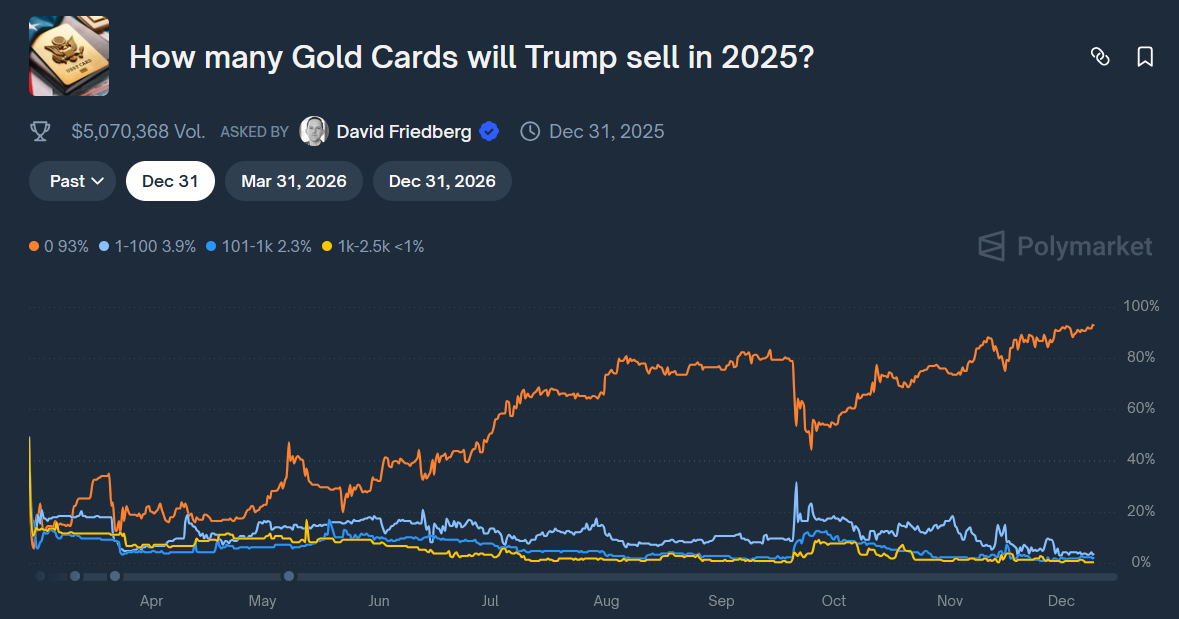
Right now, the market is pricing zero Gold Card sales for 2025 at 90% likelihood. It's been months since Trump announced this. Potential buyers and their legal teams have had time to weigh the constitutional risk. The odds aren't in Trump's favor. The legal barrier is significant, and the market is reflecting that reality.
This creates a legitimate trading opportunity. If you go with the crowd at 90% odds, you're looking at a roughly 10% gain if the prediction holds. That might seem modest, but conservative trading compounds. Small, consistent wins across multiple markets add up over time. You're taking on minimal risk to capture a fairly predictable outcome.
The timeline matters here. We're late in the year. Unless something dramatic shifts in the courts or Trump finds an unexpected legislative path forward, the market should trend closer to certainty as December approaches. A 90% position now could easily move to 95% or higher in the final weeks. That steady compression of odds is where patient traders capture value.
Insiders will always have an advantage. Legal teams working directly with Trump's administration, congressional staff monitoring the litigation, immigration attorneys tracking court filings: these people get information weeks or months before the general market does. A favorable court ruling or unexpected regulatory shift could move the needle fast. But the collective intelligence seems confident on this one.
Thousands of people with real money on the line are converging on the same conclusion: Gold Card sales in 2025 are unlikely. That kind of market alignment reflects genuine legal analysis, timing constraints, and a shared understanding of constitutional power structures.
The market sees where this is heading. Our research points the same direction.
Free Report: This is a sample report showcasing the type of analysis and research depth you'll receive regularly with a Saygun Research subscription. Subscribers get full reports with comprehensive source citations, real-time market updates, and monthly performance reviews.
When it comes to absolution, a pardon from the President of the United States is one of the highest forms that one can receive in their life. With a stroke of a pen, their crimes, which usually are federal in nature and therefore have a conviction rate of over 90%, are forgiven. The person is free from any punishment and legal liabilities that they may have had to receive due to their conviction albeit the crime will still be on their records. Barring impeachments, the President has the power to pardon anyone convicted of federal crimes. So this brings up the question: who will Trump pardon this year? Well folks, we would like to put forward Changpeng Zhao, more commonly known as CZ and the former CEO of Binance, as the most likely candidate for a pardon this year.
First let us look over the background of Chanpeng Zhao or as we will refer to him from this point onwards, CZ. He was born in Jiangsu Province in China in 1977. His family moved to Canada in the late 1980s where he earned a degree in Computer Science from McGill University. He then proceeded to get an internship with a subcontractor for the Tokyo Stock Exchange and in 2005, he moved to Shanghai where he started a business called Fusion Systems which specialized in automated high frequency trading and systems. After hearing about Bitcoin from Bobby Lee, CZ went all in, selling his apartment in Shanghai to invest in Bitcoin. In 2017, he founded Binance which after less than a year would become the largest Cryptocurrency Exchange in the world which also made him a billionaire.
However, his and Binance's legal troubles would also begin soon after where in 2019, Binance would be banned in the US and another entity called Binance US would be created so as to comply with all US regulations. In 2021, Binance would be investigated by the IRS and DOJ for money laundering and Tax Evasion. 2022 saw the company being investigated by the SEC for their 2017 ICO which the SEC alleged was an illegal sale of a security. In November 2023, after being charged with violating the BSA or Bank Secrecy Act due to failing to maintain an effective anti money laundering program at Binance, CZ would plead guilty. He was sentenced to four months in prison after taking a plea deal and Binance agreed to settle for $4.3 Billion.
With all his legal issues, the question is then, why would President Trump pardon CZ? In his Second Term, the President who was once a Crypto Skeptic is now one of its biggest proponents and in fact, he helped launch his family's own crypto venture called World Liberty Financial or WLFI for short which was co-founded by his sons and the sons of his envoy to the Middle East and Russia, Steven Witkoff. It is alleged that before seeking a pardon, Binance helped with the launch of WLFI's stable coin, USD1 by helping write the basic code that helps power the Cryptocurrency. It is also alleged that $2 billion worth of USD1 still remains in Binance's Wallets.
Now this is all speculation but what is not speculation is that Donald Trump wants to make the United States a Crypto powerhouse. There is even a whole working group from the White House that is dedicated to making that a reality with there even being a report that is available for reading on the official White House Website. He even appointed David Sacks, a known Crypto Advocate, as the White House Crypto and AI Czar. During his 2024 presidential campaign, he made an appearance in the 2024 Bitcoin Conference and gave the keynote address where he outlined his vision and policies for Crypto's future in America.
This is now where the pardon for CZ makes more sense as if it were just because of WLFI which Trump is no longer officially involved with, it would been seen as a pardon for a personal favor but if one were to consider the fact that this administration is very friendly with the Crypto Industry, a pardon for CZ makes sense from a policy stand point, Why? Because the previous administration under Joe Biden and especially under former SEC Chair Gary Gensler were seen as really hostile to the industry and as the timeline shows, CZ was convicted during the Biden administration.
By pardoning CZ, it would send a signal to the Crypto industry that it is welcome in America and that they may pursue not only their business but their values of privacy and decentralization without much interference from the federal government. It would also allow Crypto entrepreneurs and founders to start companies and do business without the fear of an investigation or persecution. This is why we think that a pardon for CZ is likely as it aligns with Trump's policy to make America the go to destination for Cryptocurrency related businesses.
So the real question becomes: who else might Trump pardon in the crypto space?
The answer depends on how you read the administration's intentions. Is this a one-off gesture to a major figure, or the opening move in a broader rehabilitation of crypto founders and executives who faced prosecution under the previous regime? The pardon itself suggests the latter, but we can look deeper into what informed people actually think will happen.
Prediction markets work differently than traditional forecasting. Everyday people risk real money on what they believe will happen. When thousands are financially motivated to find the truth, the collective intelligence often outperforms traditional news.
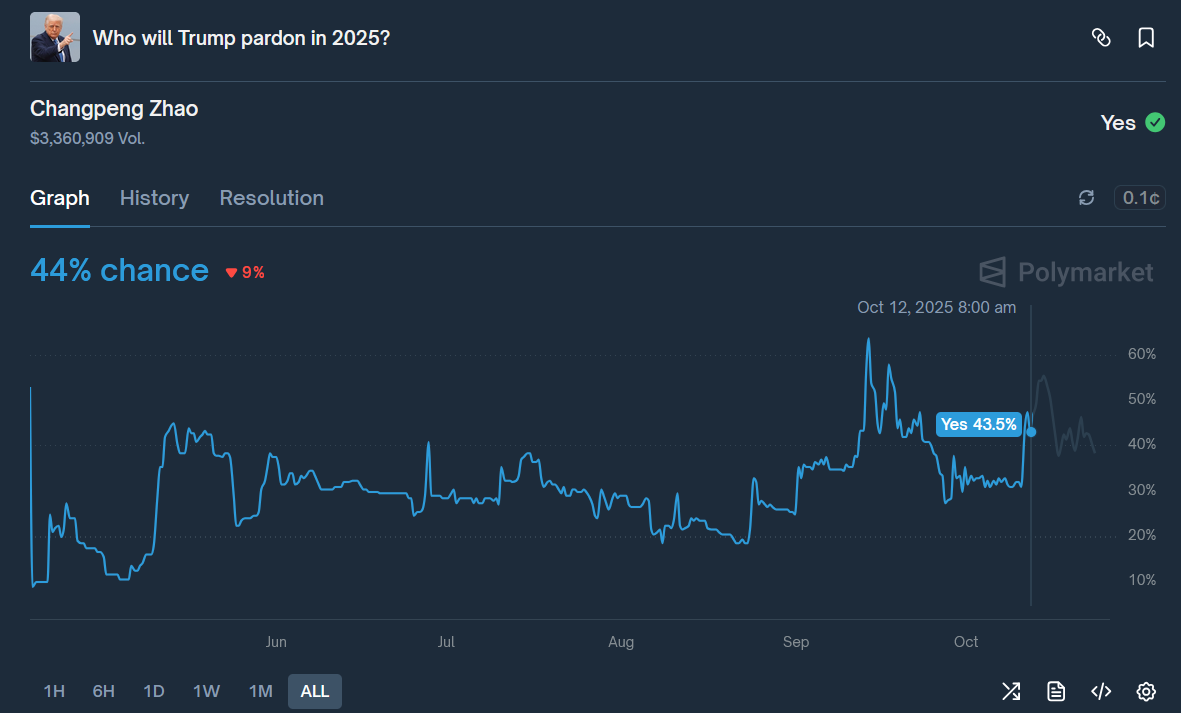
Right now, prediction markets are pricing CZ's pardon at around 43% likelihood. That's a notably higher probability compared to other potential pardons, which suggests the market has reason to believe he's more likely than most. People don't converge on the same conclusion without signal. Whether that's insider knowledge, pattern recognition from his strategic importance to the industry, or recognition of how aligned he is with this administration's crypto vision, the market is treating him as meaningfully different from other candidates. That positioning carries weight.
This is a higher risk, higher reward market. The 43% odds mean you're betting against consensus if you take the position. But that's also where opportunity lives. There's genuine conviction behind this probability, not just casual speculation. The crypto community, legal observers, and people with real money on the line are converging on the idea that CZ has a real shot at getting his conviction reversed or pardoned.
Our research points the same direction. The policy alignment is there. The signal from Trump's pivot toward crypto is unmistakable. CZ's interests and capabilities align very conveniently with the administration.
Retroactive Disclaimer:
Editor's Note: This report was originally published October 12, 2025. At the time of writing, prediction markets priced CZ's pardon at approximately 43%. President Trump issued the pardon on October 23, 2025. Those who positioned at the reported odds would have realized approximately 138% gains. This analysis serves as a historical reference demonstrating how prediction market signals aligned with subsequent policy outcomes.
Free Report: This is a sample report showcasing the type of analysis and research depth you'll receive regularly with a Saygun Research subscription. Subscribers get full reports with comprehensive source citations, real-time market updates, and monthly performance reviews.
This contradicts Altman's own statements about avoiding short-term temptations. In an August 2025 interview with Cleo Abrams, he noted: "There's a lot of short-term stuff we could do that would really juice growth or revenue or whatever and be very misaligned with that long-term goal. And I'm proud of the company and how little we get distracted by that. But sometimes we do get tempted." When pressed for examples, Altman cited the decision not to create "a sex bot avatar in ChatGPT yet."
Neither Dia nor Comet has demonstrated the ability to challenge Chrome's dominance or achieve sustainable profitability as standalone products. Chrome maintains over 3 billion users. The AI browser category remains experimental, appealing primarily to early adopters willing to accept reliability issues for novel features.
ChatGPT agent represents OpenAI's current approach to browser automation: augmenting existing browsers rather than replacing them. The system requires users to grant significant permissions and operates with limitations, including prompt injection vulnerabilities similar to those affecting Anthropic's implementation.
The evidence suggests OpenAI will likely not release a standalone browser by October 31, 2025, but the outcome remains uncertain.
Yet the market tells a different story. We can look to prediction markets to understand what informed people actually think will happen. Prediction markets work differently than traditional forecasting. Everyday people risk real money on what they believe will happen. When thousands are financially motivated to find the truth, the collective intelligence often outperforms traditional news.
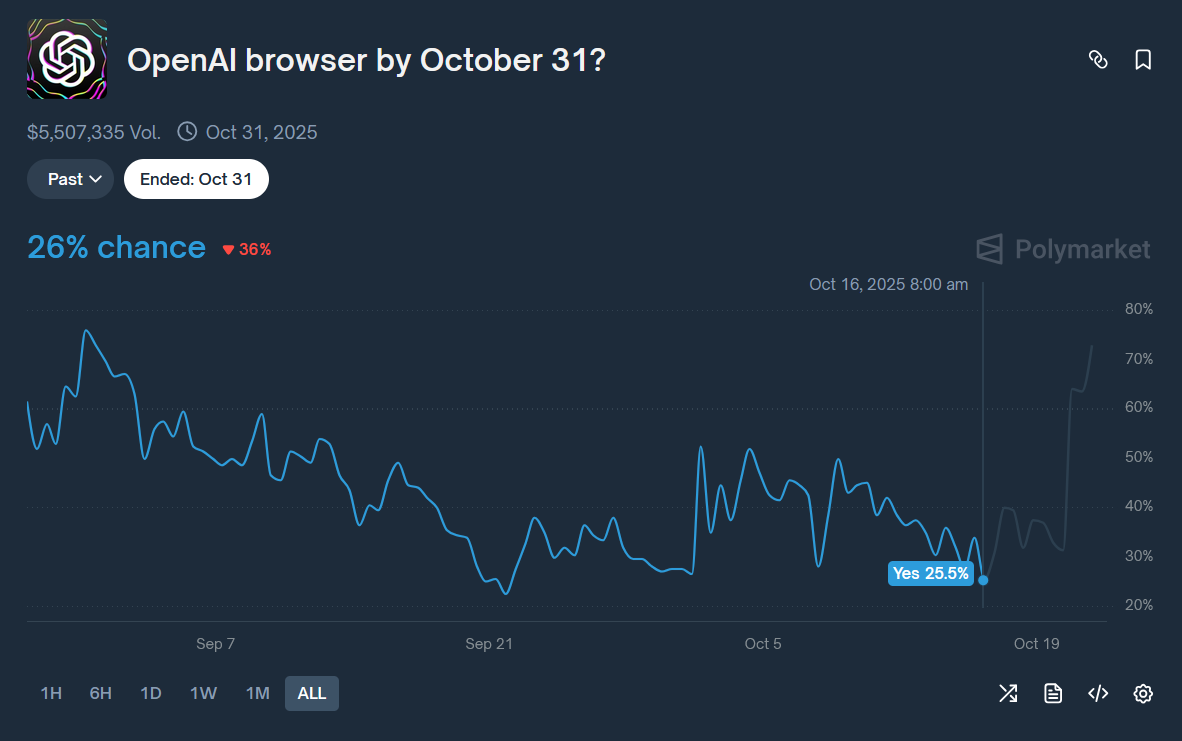
At the time of writing on October 19, 2025, prediction markets were pricing a browser release at approximately 84%, meaning "no browser by October 31" was priced at only 16%. Our research points toward no release. The market is pricing the opposite.
This creates an asymmetrical opportunity. Most of the market believed a browser release would happen despite the absence of any public information suggesting imminent launch. No beta was announced. No announcement was made. Yet the market had conviction. Rumors suggest the largest positions in this market were held by OpenAI insiders, and the market appeared to be pricing their knowledge rather than public signals. When you're going against 84% market conviction with research that points the other direction, you're either missing something or positioned for significant gains if you're right.
Our research points toward caution and extended timelines. The market reflected confidence in a near-term release. The outcome would reveal which side had better information.
Post-Mortem Note (October 21, 2025)
OpenAI released a standalone browser on October 21, 2025.
Our research was incorrect. The market was right. This outcome illuminates a crucial pattern: insider knowledge in tech markets, particularly around OpenAI and Google, runs deeper than public signals suggest. The market was pricing what insiders knew, not what the public could see. We will weigh insider positioning signals more heavily in future analysis, especially when market odds diverge sharply from what public information alone would justify.
Free Report: This is a sample report showcasing the type of analysis and research depth you'll receive regularly with a Saygun Research subscription. Subscribers get full reports with comprehensive source citations, real-time market updates, and monthly performance reviews.